
What’s Up? Stock
Railroad Weekly February 16, 2026

Inside This Issue
· What’s Up? Stock: RR Equity Prices Jump Again
· Speedway Fray: UP Again Accuses CP of Merdian Mischief
· Desert Diversion: BN’s Phoenix Play Reflects Inland Push
· Florida Fresh: CSX Moves to Renew its Loco Fleet
· Choo Choo Trin: Trinity’s Latest Railcar Outlook
· Cold Warrior: Major Miner Says Market for Steel Less than Ideal
· Oh Jeez, Who’s Got the Keys? RRs Beware, Robot Trucks Advancing
· Building Boom: Demand Strong for Construction Aggregates
· This Week: Class I CEOs Take the Stage
Track Talk
“In seeking approval of the transaction that created Canadian Pacific Kansas City Limited, Applicants stated that the merged railroad would ‘continue to maintain efficient operations serving existing gateways wherever traffic levels warrant’… CPKC has not been meeting that commitment.”
-Union Pacific filing with the STB
The Latest
· Railroad stock prices jumped again last week—the second week in a row—as investors reallocate capital to sectors other than information technology. They’re presumably more optimistic about the industrial economy as well. Whatever the reason, North America’s five publicly-traded Class I carriers are now 8% to 15% more valuable than they were just two weeks ago. All five Class I stocks, furthermore, are now up on a y/y basis. Will the gains hold?
· Railroad investors will have lots of additional information to digest this week. The chief executives of Union Pacific (Jim Vena), CSX (Steve Angel), Canadian National (Tracy Robinson), and CPKC (Keith Creel) are all scheduled to address a Barclays investor event in Miami. J.B. Hunt’s CFO will speak there as well, offering updates on the intermodal market. Creel, meanwhile, will also address a Citigroup event in Miami this week, as will CN’s CFO Ghislain Houle. Naturally, we’ll hear a lot of talk about the UP-NS merger—Vena will pitch its merits as rivals highlight its flaws. We’ll surely get updates on rail freight demand. How encouraged are railroads by the recent uptick in manufacturing sentiment? Expect a fair share of tariff talk too. And ring a bell for every mention of the term “AI.”
· Also this week, we’ll get an update on consumer sentiment from America’s largest company, Walmart—it will report its Q4 earnings on Thursday. In two weeks (Feb 28th), we’ll finally get Q4 financial figures for BNSF, in conjunction with Berkshire Hathaway’s earnings release.
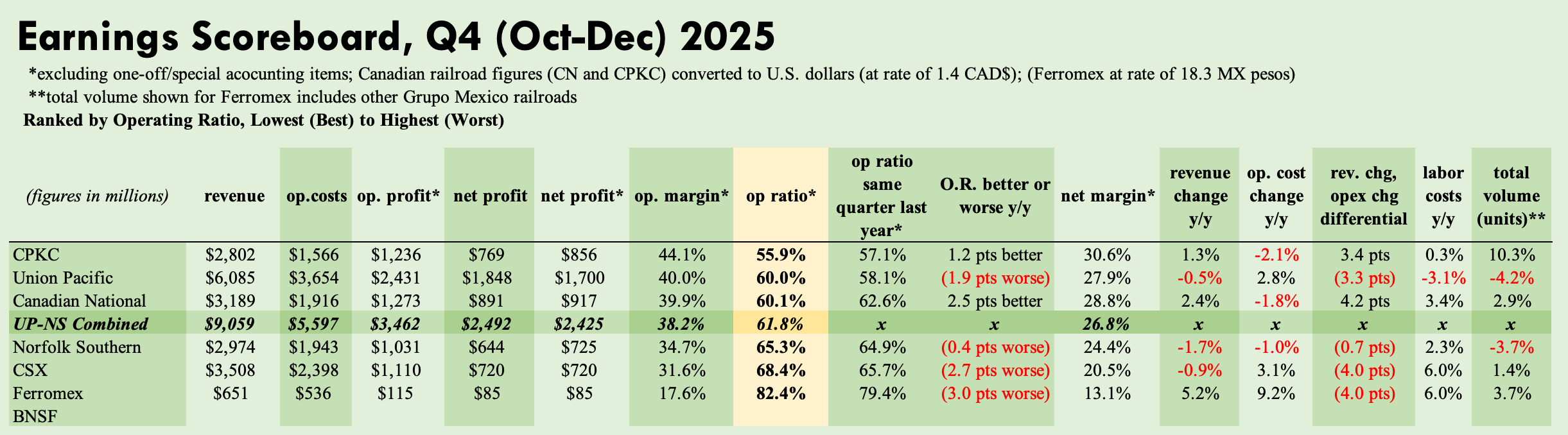
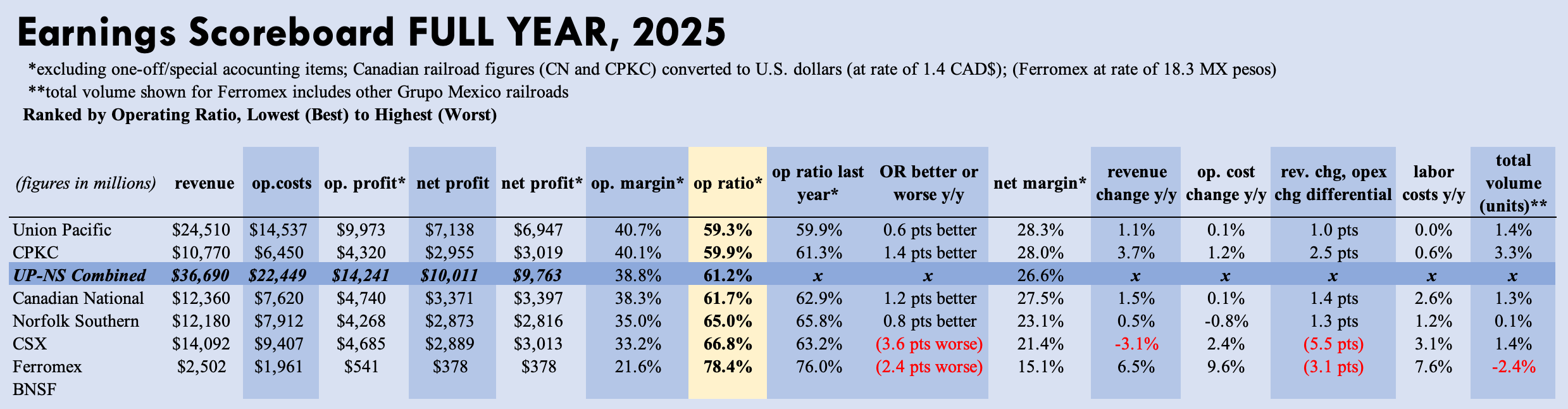
· Union Pacific, Norfolk Southern, and CSX all published their 2025 annual reports, each more than 100 pages long. UP’s report has a section advising investors of key risks associated with its Norfolk Southern takeover attempt, i.e., the possibility of having to pay NS a hefty $2.5b fee—under certain conditions—if the merger doesn’t happen. The STB, remember, is asking UP to disclose more details about these breakup conditions. At some point soon, UP will re-file its application with the additional information the STB is requiring. UP separately warned that even if approved, “the terms and conditions of the approvals… may impose requirements, concessions, limitations, or costs or place restrictions on the conduct of the combined company’s business.” You can read more about the merger risks UP raises on page 15 of the report. The Norfolk Southern report contains similar language.
· UP’s annual report is most specific about the macroeconomic risks it might face in 2026. It mentions uncertainties related to industrial production, which isn’t forecasted to grow this year. Housing starts and light vehicle sales are expected to decline. UP sees a decline in international intermodal volume. On the other hand, “higher coal demand, from elevated natural gas prices and increased coal-fired electricity production, is expected to positively impact volumes.”
· As the industry waits for UP and NS to re-file their merger application, affected stakeholders continue to express their opinions. Last week, for example, the Montana Grain Elevators Association told the STB that UP’s acquisition of NS “presents significant risk for businesses like ours and the U.S. economy. We are concerned the merger will harm shippers and their customers by eliminating competition. disrupting service, weakening the U.S. supply chain, and increasing transportation rates.”
· UP, of course, persists with its own campaign extoling the virtues of its merger. Last week, marketing chief Kenny Rocker made the case at a forum hosted by the American Coal Council. Two weeks ago, Vena spoke to members of TEGMA (the Transportation, Elevator & Grain Merchants Association). The railroad maintains an active pro-merger social media campaign as well, posting—for example—about its “committed gateway pricing” and “jobs-for-life” pledges.
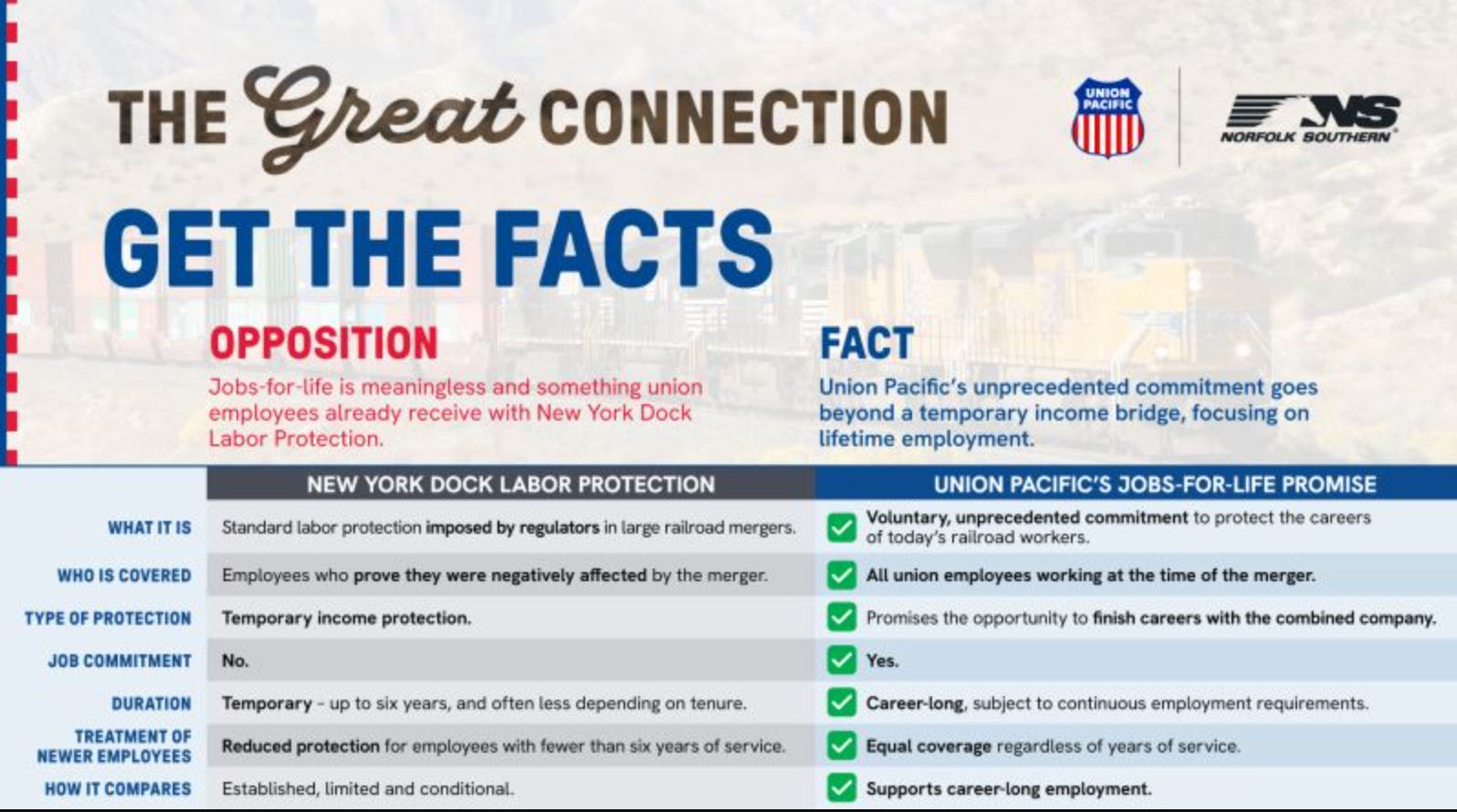
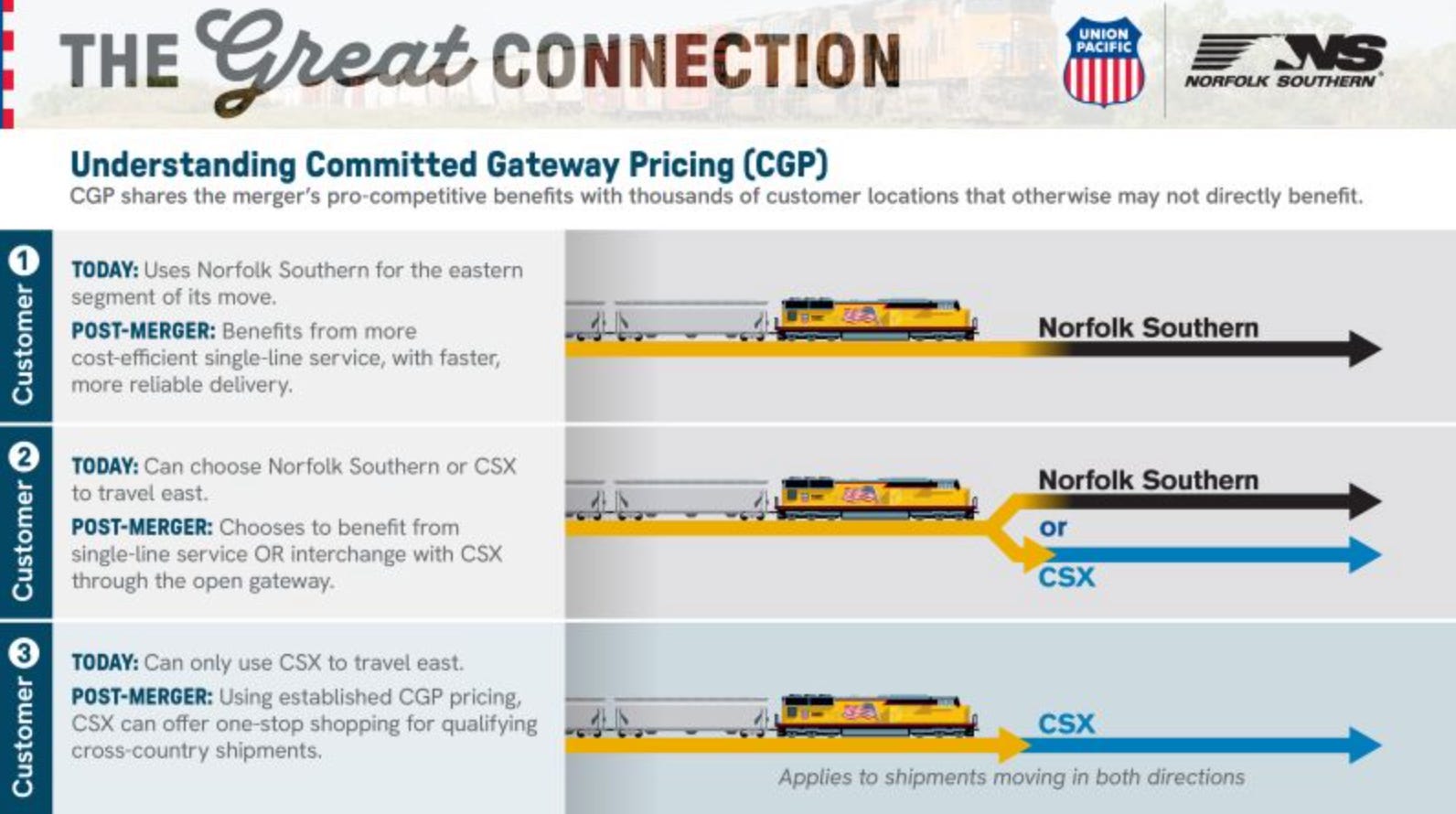
· Regarding that jobs-for-life pledge, industry analyst Daniel Bostek for one, isn’t all that impressed. He emphasizes its relevance to just current employees, not future employees. Writing specifically about conductors, he explains: “The agreement protects roughly 8k current SMART-TD members. But railroad employment typically turns over 3-5% annually through retirements and attrition. Within a decade, you’re talking about thousands of new hires who have no such guarantee.”
Other Developments
· The BLET union celebrated the 150th anniversary of a landmark 1876 labor agreement between the Central Railroad of New Jersey and its staff of locomotive engineers. It was one of the first major victories for the BLET, which was founded during the Civil War in 1863. The 1876 deal granted wage increases, seniority protections, and grievance handling, all “important building blocks that serve as the basis for many Brotherhood contracts in effect today.” Engineers with at least two years of tenure were assured $90 per month. The 1870s was a turbulent decade for the U.S. economy; it began with a railroad investment boom that proved over-enthusiastic. When the Northern Pacific could no longer find buyers for its bonds in 1873, a bank panic ensued, dragging the economy into a severe six-year recession, one of its worst ever. The Great Railroad Strike of 1877 occurred during that recession.
· BNSF loves talking about its giant rail hub project in Barstow, California. But don’t overlook the major investment it’s making in Phoenix. The Freight Flow Advisor digs deep into the strategy, centered on a $3.2b logistics park. It will have the capacity to handle about 220k containers by 2028 and more than 500k by 2050, helping to ease projected congestion at west coast ports. The idea: move containers arriving at California’s ports inland, to hubs like Barstow and Phoenix, for unloading and handling there rather than at the congested port. The Phoenix hub is also, importantly, designed to capitalize on growing freight volumes from Mexico as companies nearshore production. Local freight is growing too, with Phoenix currently one of the fastest-growing metros in the country. Firms like Intel and Taiwan’s TSMC are building multi-billion-dollar semiconductor plants in the area. Data centers are rising from the desert. And the population is growing. One challenge though, is that local residents have fought the project, concerned about issues like road traffic and water resources. As the article explains, BNSF’s Phoenix investment gives “a preview of how inland hubs, nearshoring, and local politics will reshape network strategy over the next 10–20 years.” For large importers and manufacturers, it adds, Logistics Park Phoenix will mean “a structural change in how they can design their networks.”
· In a geographically related note, some members of the Arizona state legislature—not for the first time—are again advancing a law that would cap train lengths at 8k feet. It’s unlikely to pass, but it’s a reminder that train lengths remain a hot topic.
The Speedway Conflict: UP vs. CPKC
· Union Pacific remains unhappy with CPKC and its alleged unwillingness to honor commitments related to the Meridian Speedway. Historically, it told the STB, UP delivered California-originating intermodal trains of up to 11k feet to Kansas City Southern at Shreveport, Louisiana. KCS would then move these trains along the Speedway, reaching Meridian, Mississippi. From there, Norfolk Southern would move the trains into the east. Recently, however, “CPKC has twice imposed an 8,500-foot length limit on the trains it will accept at Shreveport… which requires Union Pacific to cut trains in two before they move over the Speedway.” This is causing “significant delays.” UP wants the STB to investigate.
· CPKC, naturally, disagrees. UP is looking to coerce a change in CPKC operating rules, it said, to advance its self-serving “desire to send very long trains over infrastructure that was not built to accommodate them… Respectfully, that is UP’s
Keep reading with a 7-day free trial
Subscribe to Railroad Weekly to keep reading this post and get 7 days of free access to the full post archives.