
Accusation: Retaliation
Railroad Weekly July 13, 2026


Inside This Issue
· Kenny to Keith and Katie: Stop Acting So Shady
· UP’s Allegation: That BN, CP Are Using Intimidation, Retaliation
· The Alleged Reply: This is All a Lie (We Never Did What UP Said)
· Not Our Goal to Control: UP Clarifies Ownership Plans For 3 Entities
· Let It Grow, Let It Grow: More Encouraging Volume Trends From AAR
· Mississippi Turning: City of Meridian Drops Support For UP/NS Merger
· Can the Chair Be Fair? Bloomberg Profiles the Plight of Patrick Fuchs
· Love Thy Labor: RRs Conclude Drama-Free Round of Bargaining
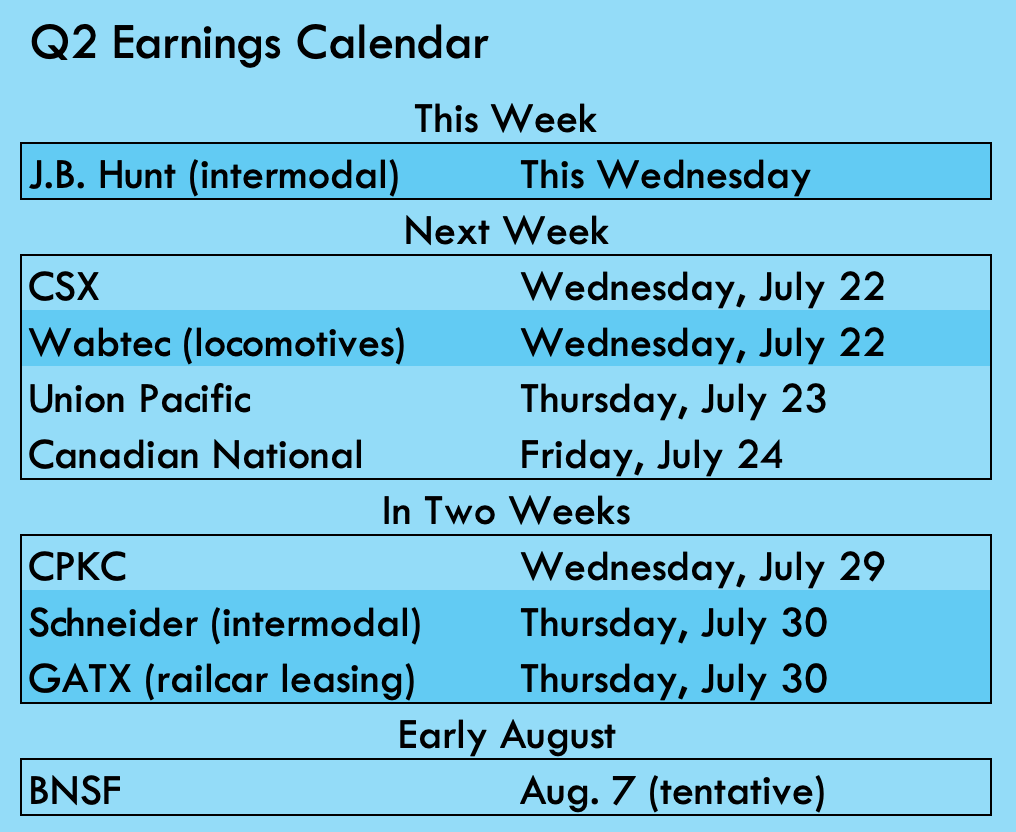
· Atilla the Hunt: IM Goliath J.B. Hunt to Report Earnings This Week
Track Talk
“Currently, we are not comfortable continuing to allow [Union Pacific and Norfolk Southern] to include our letters as statements of support for benefits they have yet to substantiate.”
-City of Meridian, Mississippi, withdrawing its support for the UP/NS merger
The Latest
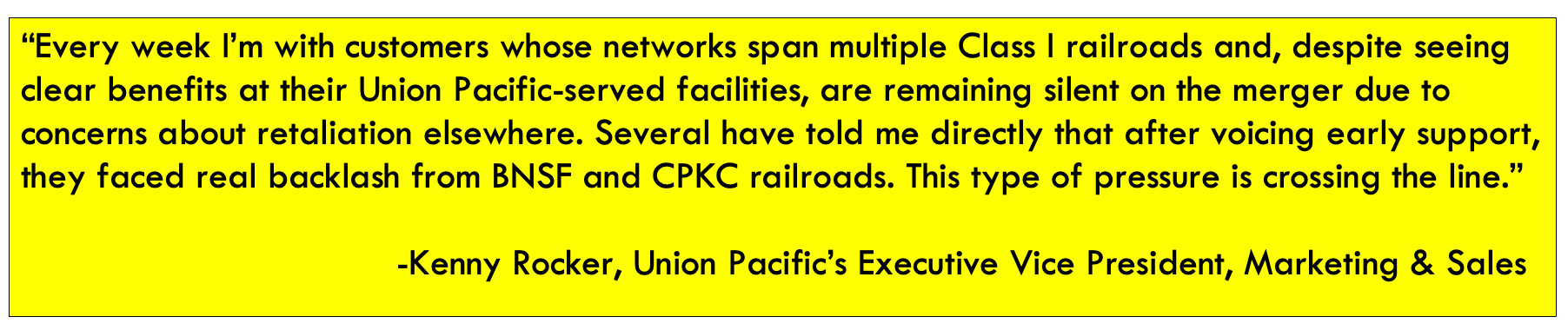
· Foul play? Union Pacific thinks so. Last week, its marketing chief Kenny Rocker published a letter to customers, in which he accuses BNSF and CPKC of inappropriately pressuring shippers (and presumably other stakeholders) to refrain from publicly supporting the UP-NS merger. Rocker says anyone subject to such pressures should speak up, informing both UP and the STB. “No customer should feel constrained when speaking about what is best for their business.” Both BNSF and CPKC told Trains Magazine they strongly deny such claims.
· Rocker says merger foes are unjustly sowing doubts about the deal, telling shippers it won’t get approved based on the STB’s recent decision to hold its review in abeyance. On the contrary, Rocker asserts, “The STB accepted our application as complete… [its] questions reflect diligence, not doubt.” He adds: “The STB has up to a 12-month statutory timeline to complete evidentiary proceedings once the application has been accepted, which sets the evidence period to close in May 2027. This requirement is an undisputed fact.” Opponents disagree, arguing the clock doesn’t start ticking until the STB lifts its abeyance designation.
· Rocker also disputes claims that the merger will create a monopoly-like entity. This ignores that “railroads carry only 27% of total ton miles in the U.S. freight market, and we compete every day with trucks, barges, ships, pipelines and air.” Even within the rail sector, UP and NS together would be roughly the same size as BNSF. “And no one has said the BNSF is too big to fail.”
· The allegations come amid an unusual occurrence: The City of Meridian, Mississippi—an important rail gateway—withdrew its support for the merger. UP and NS, the city said, “thus far have not been able to show many of the major benefits their representative stated as facts in seeking our community’s support. Accordingly, currently we are not comfortable continuing to allow [them] to include our letters as statements of support for benefits they have yet to substantiate.”
· In the meantime, Union Pacific and Norfolk Southern provided the STB with some—though not yet all—of the additional data and information the Board requested. The submission last week addressed concerns about how their merger would impact two terminal railroads (one in St. Louis and one in Kansas City) that UP and NS own jointly with other Class I railroads. UP and NS “remain firm in their commitment that they will not control them post-merger.” Ditto for TTX, the railcar pooling entity likewise jointly owned by the Class Is.
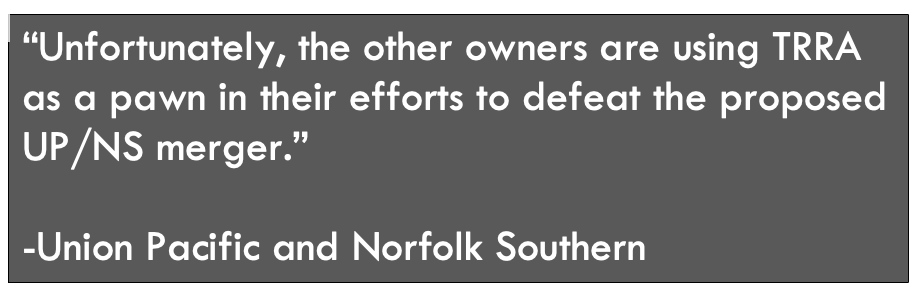
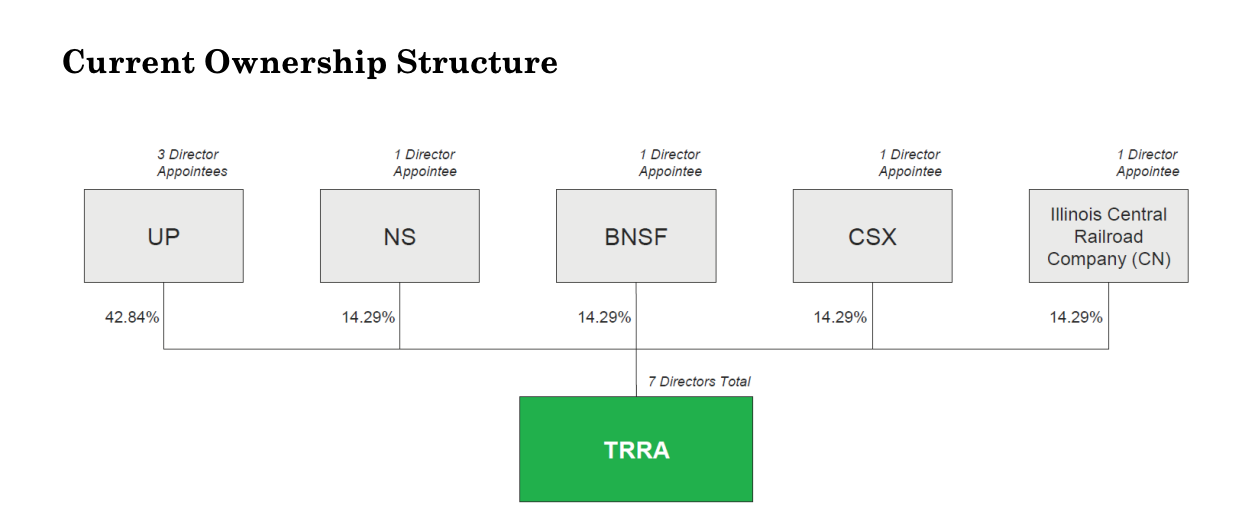
· UP and NS, in their latest filing, were quick to snap at rivals keen on stopping the merger, noting that BNSF, CPKC, and CN didn’t even show up to a special meeting on ways to reduce Union Pacific’s ownership in the St. Louis terminal railroad (TRRA). UP and NS have until July 27th to submit the additional information the STB is requesting. As a reminder, the Board accepted their merger application on May 28th but held the review process in abeyance. It wants to collect and examine more information from the two railroads before moving forward. Even so, UP said again this won’t affect the original schedule for review. It’s still “working constructively with the STB toward a mid-2027 completion.” In other words, it wants to have the merger finalized by around this time next year. A realistic goal? We’ll find out.
· Also still unfolding in the UP-NS saga: The legal process of discovery, in which interested parties can solicit information and documents from the two railroads. As of Friday, they’ve received 353 discovery requests, and are “working diligently to identify and produce materials.” But UP and NS aren’t happy about it. “The scope of documents, communications, information, and data sought by these discovery requests is unprecedented and far exceeds the needs of this proceeding.” They claim to have already “produced more than 130k pages of documents and more than 1,600 GB of data in response to discovery requests.”
Elsewhere Around the Industry
· A “millennial data whiz” dodging politics as he decides the fate of an economically vital U.S. industry? Bloomberg’s Zach Williams profiles STB chair Patrick Fuchs as he navigates fresh questions about the Board’s independence. The questions arise as Fuchs and the STB review the most consequential railroad merger in decades, determining whether it meets the legal requirement of enhancing competition. In the background stands the June 29th Supreme Court decision allowing Presidents to fire independent agency regulators like Fuchs, for any reason, “including a ruling he doesn’t like,” as the article explains. President Trump, remember, accepted a Union Pacific donation to fund his White House ballroom construction. He also met with UP’s chief Jim Vena in the White House, praising the merger deal. That said, “Trump hasn’t helped Union Pacific with anything close to the enthusiasm with which he plugged Paramount’s pursuit of Warner Bros. Discovery Inc,” according to the article. Separately, Trump fired STB member Robert Primus without cause last year, perhaps because he was the only member to vote against the Canadian Pacific-Kansas City Southern merger. However, one mitigating factor in this merger case is that many of the deal’s loudest opponents, including powerful energy companies, are “also friendly with the [Trump] administration.” Will the President put his thumbs on the scale, for or against? If so, will the Board feel pressured to follow along, lest they lose their jobs?
· Remember the 2022 U.S. railroad strike that almost was, averted only after Congress imposed a settlement? Well, those bad memories are fading farther into the distance. Labor relations these days are rather harmonious, relatively speaking. Last week, the
Keep reading with a 7-day free trial
Subscribe to Railroad Weekly to keep reading this post and get 7 days of free access to the full post archives.